Let's start with a story.
The story of a founder, Jenny, with entrepreneurship running through her veins.
She's smart, has a thousand ideas per second, loves action and is great at relationship building. So, obviously, she starts a business.
She brings in her first sales and soon, she's building a small team around her. Every monday morning, everyone gets their marching orders from Jenny and they're good to go for the week.
Fast forward a few years later and the team is now 20+ people.
The team can't all fit in the meeting room now, and Jenny is finding it harder and harder to see what people are doing.
Things aren't moving as quickly as she'd like them to, and she's feeling less and less effective at communicating with team members.
Yet, she soldiers on and tightens her grip on things. Afterall, she IS the captain of this ship, isn't she?
Pretty soon, her calendar is looking nothing like what it used to.
She's spending more time in internal meetings than on calls with prospects and clients, something she used to love doing.
She's being pulled into every decision and feels like without her around, the whole thing would fall apart.
Sunday evenings now feel like a giant train looming ahead in the distance, barging towards her at full speed to knock her off.
Jenny is now trapped in her own business, hating every minute of it yet unable to get out.
Does Jenny's story feel familiar to you?
If you're a founder that's scaling her team, here are 3 ways you can avoid going down the path Jenny went down on.
Principle no. 1 : it's never too early to clarify roles
The mistake that founders make when they're hiring is to keep roles vague.
It's a small business, so people will figure their roles out as they go right? Shouldn't people be able to do a little bit of everything when teams are small?
This is most definitely true.
But keeping roles generic and expecting people to figure things out on the fly, with no documented roles and responsibilities, is also a recipe for chaos.
So you want to clarify what people are really doing : not in terms of their daily tasks; this should be for them to decide HOW to carry out their jobs; but in terms of their ACCOUNTABILITIES : i.e. what other people can expect from them.
And this shouldn't be set in stone. These accountabilities should be updated as they evolve, which they will inevitably do.
Which brings me to your own roles and accountabilities as a founder and business owner.
This process of clarification should apply to you too.
This is your chance to focus on the following question :
What, as a founder, should be the things that ONLY YOU can do that bring value to the business?
You should write this down too for all to see, so everyone is clear on what YOU are bringing to the table and what other people can expect from you.
For instance, Jenny's accountabilities should've been :
- Bringing in new business and getting existing clients to upsell
- Setting the vision and goals for the team
Anything that needs doing that doesn't fall within anyone's scope needs to then be discussed as a team and distributed to whomever has the willingness and skill to do it until someone else comes along who is better suited to do that thing.
Creating clarity from the beginning is powerful to get the teams to own their work from the get go.
Rolebase allows you to create and update roles and accountabilities in a few clicks so the process is quick and easy.
As a founder, you need to be very comfortable getting other people to make decisions for the business.
It's really a matter of deciding who makes what decisions.
For instance, the marketing lead is responsible for sending out marketing emails. So he shouldn't be asking permission to send those emails.
What he should be doing instead is to figure out a process whereby all the parties involved in crafting those emails are giving their input as and when required.
And then he has the ultimate say on what goes out when.
This should be clearly explicited somewhere so the marketing lead isn't waiting on anyone to validate his decision to send emails. Those are HIS decisions to make, and he should feel empowered to make them.
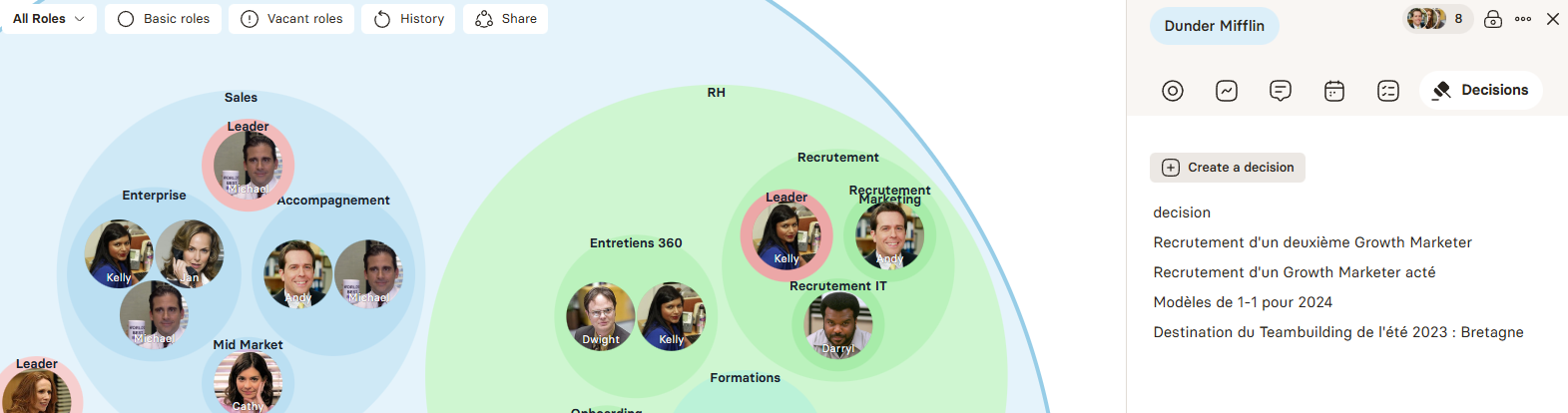
Rolebase also allows you to specify decision-making domains for each team, sub-team and roles so people are clear on who's tasked on making what decisions, rather than going around scheduling meetings to approve stuff.
Seeking approval is a major time and energy drain on the business. So the sooner you figure out a way out of it, the better.
Ok so what of the decisions that need to be made that no-one has been assigned to?
This typically falls back on the founder.
And as a founder, you absolutely should redistribute that back if you feel like it's taking your eyes off of your own priorities.
So you can talk to the teams and align with the right team member so she can include that in her decision-making domain moving on.
If that decision is a one-off, or something that requires more of a collective take rather than one person deciding, then the sooner you agree on some collective decision-making framework, the better.
Now there are tons of group decision-making frameworks out there. You can research them, discuss with the team and agree on which ones best suits the business.
Here's one that is simple and that works well in a small setting :
If a decision needs to be made, the one who has identified the problem calls for a meeting, or brings it up in a regular team meeting.
She needs to come in with a clear problem statement, and a proposal for a solution.
Now that proposal doesn't need to be perfect. It can just be a burgeoning idea of how to tackle the issue, or it can be a full-blown solution.
She lays the proposal out and each team member takes turn at commenting if they have anything to add.
At the end of the round, the proposer can amend her proposal if she wishes to include the comments.
And then each team member gets to answer the following question : 'Do you see a reason serious enough to hurt the business for this proposal not to go through?'.
Else the proposal gets through.
The reason why it's good practice not to ask people whether they agree on the proposal, but to speak out if they see an issue in the proposal going ahead, is it stops endless discussions about opinions and favours a test-and-learn approach.
The above decision-making framework is a simplified version of decision-making by consent.
Rolebase allows you to document all the decisions the teams have made so they're easy to find.
Scaling a team isn't easy.
But there are systems that can be put in place sooner rather than later to avoid the common pitfalls that founders typically find themselves in.
If you need help putting those in place, find out how Rolebase can help you here.
